
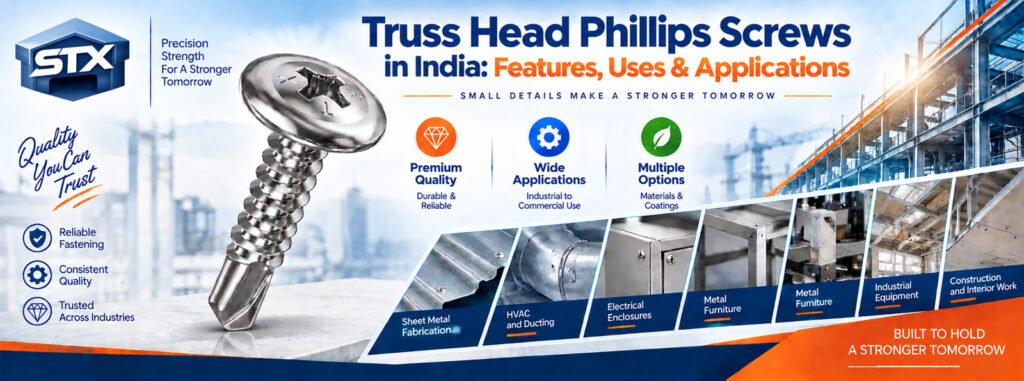
Truss Head Phillips Screws in India: Features, Uses & Applications
Truss Head Phillips Screws in India are a practical fastening choice when a project requires a broad bearing surface, a low-profile head, and easy Phillips-drive installation. However, choosing the wrong screw specification can result in poor thread engagement, damaged screw heads, inconsistent fastening, or corrosion in demanding environments.
With India’s expanding construction, fabrication, manufacturing, and metal-processing sectors, reliable fastening solutions are increasingly important. The right screw should be selected based on the material being fastened, thickness, required thread engagement, coating, drive type, and application conditions.
Truss head Phillips screws offer a useful combination of head coverage and installation convenience for suitable metal, panel, fabrication, HVAC, and general fastening applications. Understanding their design, material options, sizes, applications, and quality considerations can help buyers select the right Truss Head Phillips Screws in India and achieve more consistent fastening results.
Standards provide manufacturers and buyers with a common technical reference instead of relying only on visual inspection. BIS also provides a product manual for IS 18471:2025 covering conformity-assessment practices and declared parameters such as material type, cross recess, and thread size.
For a specific screw design, buyers should always confirm the applicable standard and manufacturer’s specification sheet before placing bulk orders. This helps ensure that the Truss Head Phillips Screws supplied are suitable for the intended fastening application.
What Are Truss Head Phillips Screws?
Truss Head Phillips Screws are fasteners designed with a broad, low-profile head and a Phillips cross-shaped drive recess. The wider head provides a larger bearing surface than many conventional screw heads, helping distribute pressure over the material being fastened. The Phillips drive also makes them convenient to install with commonly available screwdrivers and power tools.
These screws are used across applications where a secure and neat fastening point is required, including:
- Sheet metal fabrication – fastening thin metal components and panels.
- HVAC work – suitable for certain ducting, equipment, and enclosure assemblies.
- Electrical panels – used where the screw specification matches the panel material and thickness.
- General fabrication – joining suitable metal or other compatible materials.
- Furniture and hardware – useful where a broad head and compact profile are preferred.
How Does the Design Work?
The truss head provides increased surface coverage around the fastening point, while the Phillips drive transfers installation force from the driver to the screw. However, the screw must be matched to the application. Diameter, length, thread design, material, coating, and drive size all influence fastening performance.
For example, when fastening a thin metal panel, using a screw that is too long may create unnecessary penetration, while an unsuitable coating may reduce corrosion resistance in outdoor conditions.
For Truss Head Phillips Screws in India, buyers should therefore look beyond appearance and price and verify the manufacturer’s specifications before selecting a product.
Key Features of Truss Head Phillips Screws
Truss Head Phillips Screws in India are designed to provide a practical combination of a broad head profile and a Phillips drive, making them suitable for many fastening applications. Their key features include:
Broad Truss Head Design
The wider head provides a larger bearing surface than many standard screw heads. This can help distribute clamping pressure over a greater area. For example, they can be useful when fastening thin metal sheets or panels where a broader contact area is preferred.
Phillips Drive
The cross-shaped Phillips recess allows installation with commonly available Phillips driver bits. Using the correct bit size is important because a poor fit can damage the drive recess or cause cam-out during installation.
Effective Thread Engagement
The thread profile is designed to engage with the mating material effectively. Choosing the correct diameter, length, and thread configuration is important for achieving suitable engagement.
Material and Coating Options
Depending on the application, Truss Head Phillips Screws may be available in materials such as carbon steel or stainless steel, with finishes such as zinc coating. The appropriate option depends on exposure to moisture, corrosion, chemicals, and other environmental conditions.
Suitable for Multiple Applications
Common applications can include:
- Sheet-metal fabrication
- Metal panels and enclosures
- HVAC and ducting
- General industrial assembly
- Furniture and hardware applications
Important: Truss head describes the head design, while Phillips describes the drive type. If a screw also has an integrated drilling point, it can additionally be classified as a self-drilling screw.
Truss Head Phillips Screw Sizes and Specifications
Choosing the right Truss Head Phillips Screws in India is not just about selecting a longer or thicker screw. The diameter, length, thread design, head dimensions, drive size, material, and coating should match the application. For example, a screw used for light-gauge sheet metal may require a different specification from one used for a thicker metal assembly.
Key specifications to check
- Diameter: Determines the screw’s overall size and should suit the material and fastening requirement.
- Length: Select the length based on the combined material thickness and required thread engagement.
- Head diameter and height: Truss heads have a broad, low-profile design that provides a larger bearing surface. Manufacturer specifications define the allowable head dimensions.
- Phillips drive size: The correct driver size is important for proper engagement and reducing recess damage.
- Thread: Thread pitch and configuration should be compatible with the material and intended application.
- Material and coating: Carbon steel, stainless steel, and different surface finishes may be available depending on the product.
For self-drilling Truss Head Phillips Screws, drilling capacity is another important specification. For instance, some manufacturer ranges specify different drilling capacities according to screw diameter and drill-point design.
Practical tip: Before ordering in bulk, verify the manufacturer’s dimensional drawing and specification sheet rather than relying only on a product name. This helps ensure the screw’s size, drive, material, coating, and drilling capability match the actual application.
Benefits of Truss Head Phillips Screws
Truss Head Phillips Screws in India offer a practical combination of broad head coverage, easy installation, and reliable fastening for suitable applications.Choosing the right Truss Head Phillips Screws in India is not simply about picking a screw that fits the driver. Their benefits become especially useful when a project involves repeated fastening across metal sheets, panels, fabricated components, or equipment assemblies.
Broad Bearing Surface
The wider truss head distributes pressure over a larger area than many conventional screw heads. For example, when fastening thin sheet material, the broader head can provide greater surface coverage where that head configuration is appropriate for the application.
Easy Phillips-Drive Installation
The Phillips recess works with commonly available driver bits, making these screws convenient for workshop, maintenance, and production work. Using the correct bit helps reduce recess damage and improves installation consistency.
Suitable for Different Applications
Depending on their exact specification, Truss Head Phillips Screws can be used for:
- Sheet-metal fabrication
- Metal panels and enclosures
- HVAC and ducting work
- Furniture and hardware assembly
- General industrial fastening
Different Material and Finish Options
They can be available in materials and coatings suited to different environments. For example, coated steel may be considered for general applications, while stainless-steel options may be appropriate where greater corrosion resistance is required.
Practical for Repeated Assembly
Their familiar drive design and compact head profile make them useful in applications involving frequent installation or maintenance.
In short, the main advantage is not simply the screw head itself—it is choosing the right Truss Head Phillips Screw specification for the material, environment, and fastening requirement.
Applications of Truss Head Phillips Screws in India
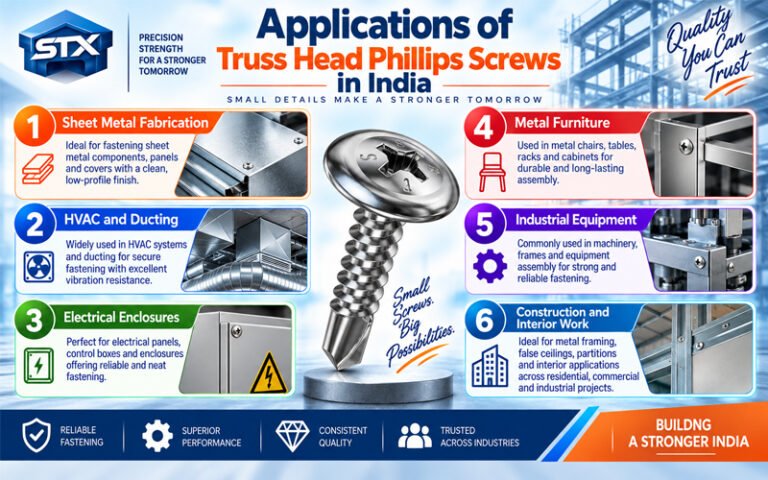
Truss Head Phillips Screws in India are used across metal fastening, fabrication, equipment assembly, panels, and other applications where a broad head and Phillips drive are suitable. Their low-profile head provides a wider bearing surface, while the Phillips recess allows installation with commonly available driving tools.
The continued demand for metal products also highlights the importance of dependable fastening solutions. India’s finished steel consumption reached 163.7 million tonnes in FY 2025–26, highlighting the scale of industries that rely on steel and metal-based products.
Common Applications
- Sheet Metal Fabrication: Suitable for joining compatible thin-gauge metal components, covers, panels, and fabricated assemblies.
- HVAC and Ducting: Used in suitable metal ductwork, equipment panels, and enclosures where the screw specification matches the application.
- Electrical Enclosures: Useful for fastening metal panels, cabinets, covers, and related components.
- Metal Furniture: Can be used for suitable metal furniture frames, brackets, panels, and assemblies.
- Industrial Equipment: Used in machinery covers, fabricated components, equipment panels, and general maintenance work.
- Construction and Interior Work: Suitable for selected metal framing, panels, fixtures, and light-duty fastening applications.
The right screw should always be selected according to material thickness, diameter, length, thread design, material, coating, and required holding performance. For outdoor or corrosive environments, the coating and material become particularly important. Also, a Truss Head Phillips screw should not automatically be described as self-drilling; the drilling capability depends on the specific screw design and point configuration.
Truss Head Phillips Screws vs Other Screw Types
Choosing the right screw is not only about size or material. Head design and drive type also affect installation, surface coverage, and the final appearance of the joint. Truss Head Phillips Screws have a broad, low-profile head that provides a larger bearing area, making them useful for suitable thin-material and metal fastening applications. Technical fastening guides describe modified Phillips truss heads as large and low-profile, particularly for applications involving metal studs and similar assemblies.
Truss Head Phillips vs Pan Head Screws
Both are non-countersunk designs, but a truss head generally has a wider, lower profile. Pan heads are commonly used for general fastening, while truss heads can provide greater surface coverage where that is beneficial.
Truss Head Phillips vs Countersunk Screws
Countersunk screws are designed to sit flush with the material after installation. Truss heads remain above the surface and are better suited when a broad bearing surface is preferred rather than a flush finish.
Truss Head Phillips vs Hex Washer Head Screws
Hex washer head screws use an external hex drive and washer face, while Phillips truss screws use a cross recess. The better choice depends on the required installation tool, access, and application.
Quick Comparison
| Screw Type | Main Advantage | Typical Consideration |
|---|---|---|
|
Truss Head Phillips |
Wide, low-profile head |
Thin-material and metal fastening |
|
Pan Head |
General-purpose design |
Moderate head coverage |
|
Countersunk |
Flush finish |
Requires suitable countersinking |
|
Hex Washer Head |
Broad bearing and socket drive |
Useful where hex-drive installation is preferred |
For drilling-screw applications, buyers should verify the applicable product standard and manufacturer’s specification. ISO 15481 provides an international reference for cross-recessed pan-head drilling screws, while IS 18471:2025 covers drilling screws with tapping screw threads and defines relevant product requirements. The applicable standard should always be confirmed against the specific screw design and product specification.
How to Choose the Right Truss Head Phillips Screws
Choosing the right Truss Head Phillips Screws is not simply about picking a screw that fits the driver. The screw must match the material, thickness, environment, and fastening requirements. A quick checklist can help avoid common installation problems.
Choose the Correct Diameter and Length
Start with the material thickness and required thread engagement. For example, a screw that is too short may not provide sufficient engagement, while an unnecessarily long screw can interfere with components behind the joint.
Check the Material
Choose the screw material according to the application. Carbon steel can be suitable for many general fastening applications, while stainless steel may be preferred where greater corrosion resistance is required. Always match the material to the working environment.
Select the Right Coating
For outdoor or moisture-prone applications, coating becomes especially important. Zinc-coated or other corrosion-resistant finishes can provide additional protection, but the appropriate finish depends on exposure conditions.
Match the Phillips Drive
Use the correct Phillips driver bit for the screw. For example, an improperly sized bit can cause cam-out, damaging the recess and making installation difficult.
Consider the Application
For sheet-metal fabrication, panels, HVAC assemblies, or general metal fastening, consider the material thickness, head clearance, and required holding performance before ordering.
Verify Manufacturer Specifications
Before purchasing, check the diameter, length, thread type, head dimensions, material, coating, and drive specification. For self-drilling variants, also verify the drilling capacity specified by the manufacturer.
A simple rule is: Application → Material → Size → Coating → Drive → Manufacturer Specification. This approach helps buyers select suitable Truss Head Phillips Screws in India with greater confidence.
How to Install Truss Head Phillips Screws Correctly
Installing Truss Head Phillips Screws in India correctly is important for achieving a secure joint and avoiding damaged screw heads or surface damage. The process is straightforward when the screw, driver bit, and installation method match the application.
Step 1: Choose the Correct Screw
Select the screw based on the material thickness, required length, diameter, thread type, and coating. For example, when fastening a thin metal panel, avoid using a screw that is unnecessarily long or has an unsuitable thread design.
Step 2: Use the Correct Phillips Bit
The driver bit should match the screw’s Phillips recess. A poorly fitting bit can cause cam-out, damaging the screw head and making removal difficult.
Step 3: Position the Materials Properly
Align the materials before driving the screw. For example, when joining two metal sheets, keep both surfaces firmly positioned so they do not shift during installation.
Step 4: Drive the Screw Straight
Keep the drill or screwdriver aligned with the screw axis. Apply steady pressure and use a suitable speed rather than forcing the screw into the material.
Step 5: Avoid Overdriving
Stop when the truss head is properly seated. Excessive tightening can deform the head, damage the coating, or distort the material around the fastening point.
Step 6: Check the Finished Joint
After installation, check that the screw is firmly seated, the Phillips recess is undamaged, and the materials remain properly aligned. For critical applications, always follow the manufacturer’s recommended installation specifications.
Common Mistakes When Using Truss Head Phillips Screws
Using the right Truss Head Phillips Screws in India is only part of getting a reliable fastening joint. Installation mistakes can damage the screw, workpiece, or driver and may reduce fastening consistency.
Using the Wrong Phillips Bit
A bit that does not properly match the screw recess can slip or cam out, damaging the drive. Phillips Screw Company highlights cam-out reduction as an important consideration in screw-drive design.
Example: A loose-fitting bit slips repeatedly while fastening a metal panel, leaving the Phillips recess damaged.
Fix: Use the correct Phillips bit size and keep it aligned with the screw.
Over-Tightening the Screw
Applying excessive force can damage the drive recess, deform thin sheet material, or affect the screw head. Truss heads provide a broad bearing area, but that does not mean they should be treated as high-torque fasteners.
Fix: Use controlled pressure and follow the manufacturer’s installation or torque guidance when available.
Choosing the Wrong Screw Length
A screw that is too short may not provide adequate engagement, while an unnecessarily long screw can interfere with components behind the material.
Fix: Select the length according to the combined material thickness and required thread engagement.
Ignoring Material and Coating
Using a screw without considering moisture, outdoor exposure, or the materials being joined can lead to premature corrosion or an unsuitable joint.
Fix: Match the screw material and coating to the application environment.
Choosing Only by Price
The cheapest screw is not always the most economical choice. Head consistency, thread quality, coating, dimensional accuracy, and drive performance all affect installation and long-term results.
Quick rule: Check the size, thread, material, coating, drive, and application before placing a bulk order.
How to Identify High-Quality Truss Head Phillips Screws
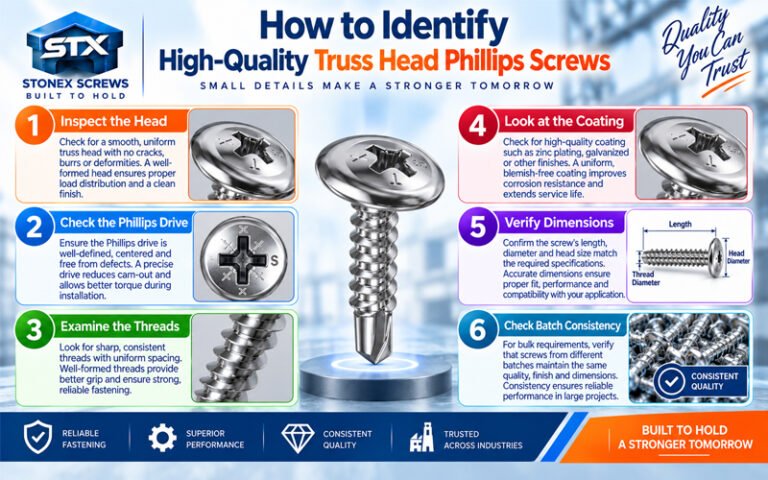
Choosing high-quality Truss Head Phillips Screws in India is not just about appearance or price. Small differences in the head, threads, drive recess, and coating can affect installation and long-term fastening performance. Before placing a bulk order, check these key points:
- Inspect the head: The truss head should have a consistent shape and a smooth, uniform surface. An uneven head can affect how the screw sits against the material.
- Check the Phillips drive: The cross-shaped recess should be clean and properly formed. For example, if the driver bit does not seat firmly, the screw may cam out or become damaged during installation.
- Examine the threads: Threads should be consistent from screw to screw, without obvious deformation, burrs, or damaged sections. Consistent threads help provide predictable engagement.
- Look at the coating: For coated screws, check for an even finish without visible peeling, excessive patches, or bare areas. The appropriate coating should match the expected environment.
- Verify dimensions: Confirm the diameter, length, head dimensions, thread specification, and drive size against the supplier’s product specification sheet.
- Check batch consistency: A simple practical check is to compare several screws from the same batch rather than inspecting only one sample.
For example, if a screw looks well-finished but has inconsistent Phillips recesses or damaged threads, it may still create installation problems. A reliable manufacturer should be able to provide product specifications, material details, coating information, and applicable quality documentation. This combination of visual inspection and documented specifications gives buyers a more dependable way to evaluate Truss Head Phillips Screws in India.
Truss Head Phillips Screws Manufacturing and Quality Standards
The quality of Truss Head Phillips Screws in India depends on more than the appearance of the screw. Consistent head dimensions, accurate threads, a properly formed Phillips recess, suitable material, and a uniform finish all contribute to reliable fastening. For manufacturers, these details also help maintain consistency across production batches.
What Should Manufacturers Check?
A quality-focused manufacturing process should pay attention to:
- Dimensions: Diameter, length, head dimensions, and thread size should match the specified product requirements.
- Phillips drive: The cross recess should be accurately formed so the correct driver engages properly.
- Thread quality: Threads should be consistent and free from significant defects that could affect installation.
- Material: Steel or stainless steel should be selected according to the intended application.
- Finish and coating: The coating should be appropriate for the required environmental exposure and applied consistently.
- Marking and identification: Product specifications should be traceable where applicable.
For drilling screws with tapping screw threads, IS 18471:2025 covers characteristics and requirements including dimensions, thread size, materials, tolerances, finish/coating, designation, and marking. The standard covers drilling screws from ST 2.9 through ST 6.3.
Why Standards Matter
Standards provide manufacturers and buyers with a common technical reference instead of relying only on visual inspection. BIS also provides a product manual for IS 18471:2025 covering conformity-assessment practices and declared parameters such as material type, cross recess, and thread size.
For a specific screw design, buyers should always confirm the applicable standard and manufacturer’s specification sheet before placing bulk orders. This helps ensure that the Truss Head Phillips Screws supplied are suitable for the intended fastening application.
Buying Truss Head Phillips Screws in India
Buying Truss Head Phillips Screws in India should start with the application, not simply the lowest price. The right screw needs to match the material, thickness, required thread engagement, head design, drive size, material, and surface finish. This is particularly relevant as India’s finished-steel consumption reached 163.7 million tonnes in FY 2025–26, reflecting strong demand across infrastructure, manufacturing, construction, and other industries.
Before placing an order, check these points:
- Material: Choose carbon steel, stainless steel, or another suitable material based on the application and environment.
- Size: Confirm the screw diameter and length against the material thickness and required engagement.
- Drive: Make sure the Phillips recess matches the driver or bit being used.
- Coating: For outdoor or moisture-prone applications, select a finish appropriate for the expected exposure.
- Application: A screw suitable for light sheet-metal work may not be appropriate for a different fastening requirement.
- Quality: Check dimensional consistency, thread formation, head condition, coating quality, and available product specifications.
For example, if you are fastening thin metal panels, focus on the correct screw length, thread design, head coverage, and coating rather than choosing solely by price.
For bulk purchases, also ask the manufacturer about batch consistency, packaging, technical specifications, availability, and supply capacity. A reliable supplier should be able to clearly explain which screw specification suits your application.
Ultimately, the best Truss Head Phillips Screws in India are not simply the cheapest option—they are the ones whose specifications match the job.
Why Choose STX Screws for Truss Head Phillips Screws?
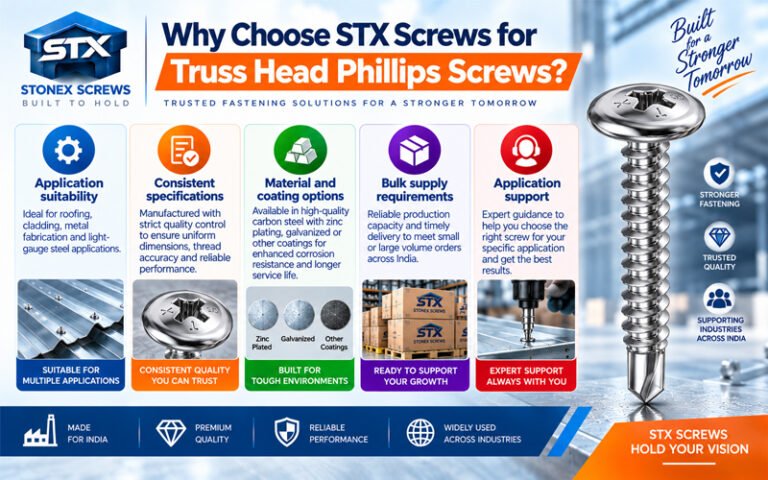
Choosing the right Truss Head Phillips Screws is not only about getting the right size. For fabrication, sheet-metal work, panels, HVAC, and general industrial fastening, consistency in dimensions, thread quality, head design, and finish can make a noticeable difference during installation.
STX Screws focuses on providing fastening solutions for different industrial and construction requirements. When selecting Truss Head Phillips Screws, buyers should consider:
- Application suitability: Choose the screw according to the material, thickness, and fastening requirement.
- Consistent specifications: Uniform head dimensions, threads, and drive recesses help support smoother installation.
- Material and coating options: The appropriate material and finish should be selected according to the operating environment and corrosion exposure.
- Bulk supply requirements: For manufacturers and contractors, consistent product availability can help simplify ongoing procurement.
- Application support: Sharing details such as material type, thickness, required size, quantity, and working environment can help identify a suitable screw specification.
For example, a fabricator fastening metal panels may need a different specification from an HVAC manufacturer assembling ducting or an industrial unit installing equipment panels. Instead of choosing one screw for every application, STX Screws can help buyers evaluate the relevant specifications for their particular requirement.
For the best results, always verify the product dimensions, material, coating, drive type, thread configuration, and application suitability before ordering. This specification-based approach helps businesses choose Truss Head Phillips Screws in India with greater confidence.
Conclusion
Choosing the right Truss Head Phillips Screws in India is not simply about selecting a screw that fits the hole. The head design, diameter, length, thread configuration, material, coating, and drive type should all match the application.
For example:
- Sheet-metal fabrication: Select a suitable diameter, length, and thread design for the material thickness.
- HVAC and ducting: Consider the material, installation environment, and corrosion exposure.
- Metal panels and enclosures: A broad truss head can provide useful surface coverage while maintaining a relatively low-profile appearance.
- Outdoor applications: Pay close attention to screw material and protective coating rather than choosing purely on price.
India’s continued demand for steel and metal products also highlights the importance of dependable fastening solutions. According to the Ministry of Steel, India’s finished steel consumption reached 163.7 million tonnes in FY 2025–26, highlighting the scale of industries that rely on steel and metal-based products.
Ultimately, the right Truss Head Phillips Screws in India are those whose specifications match the actual application. Before placing a bulk order, verify the screw dimensions, material, finish, drive compatibility, thread configuration, and applicable product specifications with the manufacturer.
For reliable results, correct specification matters more than simply choosing the cheapest option.
FAQ
Truss Head Phillips Screws have a broad, low-profile head combined with a Phillips drive. The wider head provides useful surface coverage, while the cross-shaped drive allows installation with a suitable Phillips bit. They are commonly considered for sheet metal, panels, fabrication, HVAC, and general fastening applications.
They can be used for applications such as:
- Sheet metal fastening
- Metal fabrication
- HVAC panels and ducting
- Electrical enclosures
- Equipment assembly
- General hardware applications
For example, when fastening a thin metal panel where a broader head is preferred, a suitable truss head screw can provide better surface coverage than a smaller-head screw.
Yes, when the screw specification matches the metal and application. Check the screw diameter, length, thread design, material, coating, and point type before selecting one. A self-drilling version may be appropriate for certain metal applications, while other designs may require a prepared hole.
Consider the material thickness, required thread engagement, screw diameter, and application requirements. Avoid choosing a screw based only on length or appearance.
Use the correct Phillips driver bit, keep the tool aligned with the screw head, and avoid excessive pressure or overdriving. Proper installation helps reduce cam-out and damage to the screw or material.
They can be, but outdoor suitability depends on the screw material and protective coating. For exposed environments, select a specification designed for the expected moisture and corrosion conditions.