
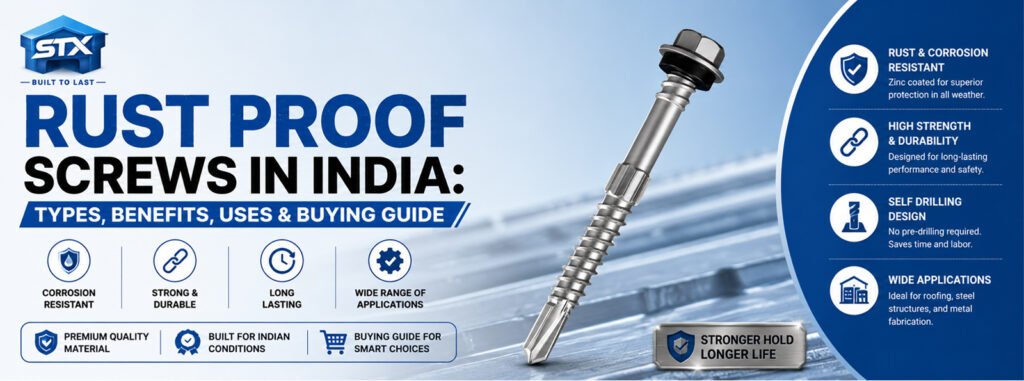
Rust Proof Screws in India: Types, Benefits, Uses & Buying Guide
Rust and corrosion can weaken fasteners, damage finished surfaces, and increase maintenance costs when screws are exposed to rain, humidity, or other harsh conditions. Choosing the right rust-proof screws can help improve corrosion resistance and provide reliable fastening for suitable applications.
However, not all rust-proof screws perform the same way. The screw material, protective coating, design, installation method, and surrounding environment can all affect how well a screw resists corrosion.
Whether you need screws for roofing, construction, sheet metal, outdoor structures, or industrial work, choosing the right type is important. This guide covers the types, benefits, applications, selection factors, installation tips, and buying considerations to help you choose the right rust proof screws for your project.
What Are Rust Proof Screws?
Rust-proof screws are screws designed to resist rust and corrosion when exposed to moisture, humidity, rain, or other environmental conditions. They are commonly used when ordinary steel screws may corrode quickly and affect the strength or appearance of the finished work.
For buyers looking for rust-proof screws in India, the right choice depends on the application, material, coating, and environmental exposure.
The term “rust proof” is commonly used in the fastener industry, but it is important to understand that no screw should automatically be considered designed to resist rust and corrosion in every environment. Performance depends on the screw material, coating, installation, and level of exposure.
How Do Rust Proof Screws Resist Corrosion?
Different screws use different methods to improve corrosion resistance:
- Stainless steel screws: Their corrosion resistance comes from the metal itself. Chromium helps form a protective passive layer on the surface.
- Zinc coated screws: A zinc coating helps protect the underlying steel from moisture and corrosion.
- Galvanized screws: A thicker zinc coating can provide stronger protection for many outdoor applications.
- Special coated screws: Additional protective coatings can improve resistance depending on the application and environment.
For example, a zinc coated self drilling screw can be suitable for roofing and sheet-metal applications where moderate corrosion protection is required. For more demanding or corrosive environments, a suitable stainless steel grade may offer better corrosion resistance, depending on the application.
Are Rust Proof Screws Really 100% Rust-Proof?
Not necessarily. Even corrosion-resistant screws can eventually corrode if they are exposed to severe moisture, salt, chemicals, or unsuitable conditions. The right screw is the one whose material and protective finish match the environment where it will be installed.
Types of Rust Proof Screws
Not all rust proof screws are made from the same material or protected in the same way. The right choice depends on where the screw will be used, how much moisture it will face, and the level of corrosion resistance required.
Stainless Steel Screws
Stainless steel screws offer strong corrosion resistance because the material itself is designed to resist corrosion. 304 stainless steel is commonly used for general outdoor and wet environments, while 316 stainless steel is better suited to severe environments, especially where chlorides or salt exposure are present.
Examples:
- Outdoor structures
- Coastal applications
- Roofing and fabrication
- Wet or humid areas
Zinc Coated Screws
Zinc-coated screws use a protective zinc layer over steel. For electroplated zinc and zinc-alloy coating systems, ISO 4042:2022 specifies requirements for steel fasteners and coating systems.
Galvanized Screws
Galvanized screws are also protected with zinc, but the coating process and thickness can vary. Hot-dip galvanized screws typically have a thicker zinc coating than many zinc-plated finishes, which can provide enhanced corrosion protection for suitable outdoor applications.
Corrosion-Resistant Coated Screws
Some steel screws use specialized protective coatings, such as polymer or ceramic-based finishes, to improve resistance to moisture and corrosion. These can be useful when a project needs additional surface protection without using stainless steel.
Benefits of Using Rust Proof Screws
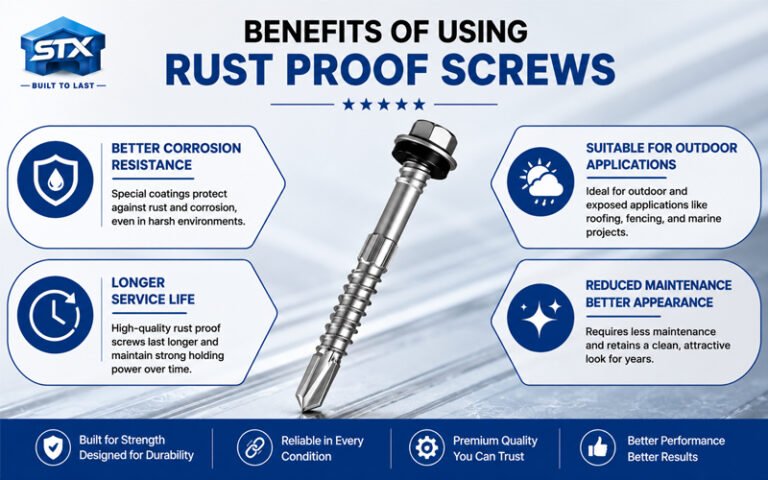
When screws are exposed to moisture, rain, humidity, or outdoor conditions, corrosion can become a serious problem. Using rust proof screws can help reduce corrosion-related issues and improve the reliability of a fastening system.
Better Corrosion Resistance
The right material or protective coating helps protect screws from moisture and corrosive conditions. For example, zinc-coated screws provide a protective coating over the steel, while Stainless steel screws offer strong corrosion resistance. The mechanical and physical properties of corrosion-resistant stainless-steel screws are covered by ISO 3506-1:2020.
Longer Service Life
Rust can gradually weaken a screw and make removal or maintenance difficult. Choosing a suitable rust resistant screw can help maintain the fastening connection for longer, especially in applications exposed to moisture.
Suitable for Outdoor Applications
Rust proof screws are useful for applications such as:
- Metal roofing and roofing sheets
- Steel framing
- Sheet metal fabrication
- Outdoor structures
- Industrial equipment
- Areas exposed to humidity or occasional water.
Reduced Maintenance
Corroded screws may need frequent replacement and can become difficult to remove. Using the right corrosion-resistant screw can reduce maintenance requirements and help keep the finished installation in better condition.
Better Appearance
Visible rust stains can affect the appearance of roofing, panels, and finished structures. A suitable corrosion-resistant finish helps maintain a cleaner appearance over time.
Where Are Rust Proof Screws Used?
Rust proof screws are mainly used in applications where fasteners may be exposed to moisture, humidity, rain, outdoor conditions, or corrosive environments. Choosing the right corrosion-resistant screw helps reduce premature rusting and can improve the service life of the fastening connection.
Roofing and Metal Roofing
Rust resistant screws are commonly used to secure metal roofing sheets, roof panels, flashing, and cladding. Since roofing fasteners are exposed to rain and changing weather conditions, the material and protective finish of the screw are important.
Construction and Steel Framing
They are suitable for steel framing, structural connections, wall panels, and general construction work where moisture exposure can become a concern.
Sheet Metal Fabrication
In fabrication, rust proof screws can be used for metal panels, enclosures, ducts, cabinets, and sheet-metal assemblies, depending on the material and joint requirements.
Outdoor and Industrial Applications
They are also useful for outdoor structures, warehouses, agricultural buildings, manufacturing facilities, and industrial installations where environmental exposure can accelerate corrosion.
In short: choose rust proof screws based on the base material, exposure conditions, coating or screw material, and application requirements rather than simply choosing a screw labelled “rust proof.”
Rust Proof Screws vs Regular Screws
| Feature | Rust Proof / Corrosion-Resistant Screws | Regular Steel Screws |
|---|---|---|
|
Corrosion Protection |
Uses corrosion-resistant material or protective coating |
Depends on the material and finish |
|
Moisture Exposure |
Better suited to suitable wet or humid conditions |
More suitable for controlled environments |
|
Outdoor Use |
Can suit outdoor applications when correctly specified |
May require additional protection |
|
Material Options |
Stainless steel, zinc-coated or other protective finishes |
Commonly available in standard steel |
|
Maintenance |
Can help reduce corrosion-related maintenance |
May require earlier replacement in corrosive conditions |
|
Cost |
May cost more depending on material and coating |
Often more economical |
|
Best Use |
Roofing, fabrication, outdoor and corrosion-prone applications |
Indoor or controlled environments |
How to Choose the Right Rust Proof Screw
Choosing the right rust proof screw is not simply about picking the screw with the strongest-looking coating. The right choice depends on where the screw will be used, what materials it will join, and how much moisture or corrosion it may face. Fastener selection guidance commonly considers both the screw material/coating and the surrounding environment.
Check the Base Material
First, identify what you are fastening.
- Steel-to-steel: Choose a screw designed for metal applications.
- Sheet metal: Check the drill-point design and screw thickness.
- Aluminium-to-steel: Pay attention to compatibility between different metals.
Consider the Environment
Think about where the screw will be installed:
- Dry indoor areas → standard protective coatings may be suitable.
- Outdoor areas → choose better corrosion protection.
- Coastal or high-moisture locations → consider materials or coatings designed for more demanding exposure
For example, a zinc-coated screw may be suitable for many roofing and general outdoor applications, while a more corrosion-resistant material may be preferable in harsher environments.
Choose the Correct Size
Check the screw diameter, length, thread type, and drill-point capacity. A screw that is too short may not provide sufficient engagement, while an unnecessarily long screw can create installation problems.
Check the Head and Drive Type
Select the head style according to the application. For roofing and metal framing, hex washer head screws are commonly used because they can provide firm seating and, where applicable, work with sealing washers.
Verify Product Specifications
Before buying, check the manufacturer’s material, coating, dimensions, application range, and available technical documentation rather than choosing only by the term “rust-proof.”
How to Install Rust Proof Screws Correctly
Installing rust proof screws correctly is just as important as choosing the right screw. Poor installation can damage the coating, strip the threads, deform the material, or reduce the protection against moisture and corrosion.
Prepare the Materials
Before installation, check that the screw size, drill point, head type, and coating are suitable for the material. Clean away dust, metal chips, oil, or debris from the fastening area.
Use the Correct Driver and Bit
Choose a compatible screwdriver, screw gun, or drill driver with the correct bit or socket. For self-drilling rust proof screws, a separate pilot hole is normally unnecessary when the screw is suitable for the material thickness.
Keep the Screw Straight
Position the screw at approximately 90° to the surface and apply steady pressure while starting. This helps the drill point engage properly and reduces the risk of damaging the screw or material.
Control Speed and Pressure
Avoid excessive RPM or pushing force. High speed can generate heat and damage the drill point, while excessive pressure can cause point breakage or chipping.
Avoid Over-Tightening
Once the screw is properly seated, stop driving. For roofing screws with sealing washers, tighten enough to create a proper seal without crushing or deforming the washer. Over-tightening can damage the washer and allow moisture penetration.
Inspect the Finished Fastening
Finally, check that the screw is straight, secure, and properly seated, with no damaged coating, stripped threads, or excessive deformation.
Common Mistakes When Buying Rust Proof Screws
Buying rust proof screws based only on price or appearance can lead to rust, premature failure, and unnecessary replacement costs. Here are some common mistakes to avoid:
Choosing the Screw Only by Price
A cheaper screw may use a thinner or less suitable protective coating. The lowest price is not always the lowest overall cost if the screws need early replacement.
Ignoring the Material and Coating
Not all corrosion-resistant screws offer the same protection. Zinc-coated, galvanized, and stainless steel screws have different corrosion-resistance characteristics. For example, a coating suitable for a dry indoor application may not be appropriate for constant outdoor moisture.
Assuming “Rust Proof” Means 100% Rust-Proof
The term rust proof screws describes improved corrosion resistance, not unlimited protection. Always choose the screw according to the application and environment.
Buying the Wrong Screw Size
Using a screw that is too short can reduce fastening performance, while an unnecessarily long screw can cause installation or clearance problems. Always match the length, diameter, thread, and head type to the application.
Ignoring Installation Quality
Over-tightening or damaging the coating during installation can expose the underlying steel to moisture and accelerate corrosion.
Simple rule: Before buying, check material, coating, size, application, and manufacturer specifications—not just the price or shiny finish.
How to Identify High-Quality Rust Proof Screws
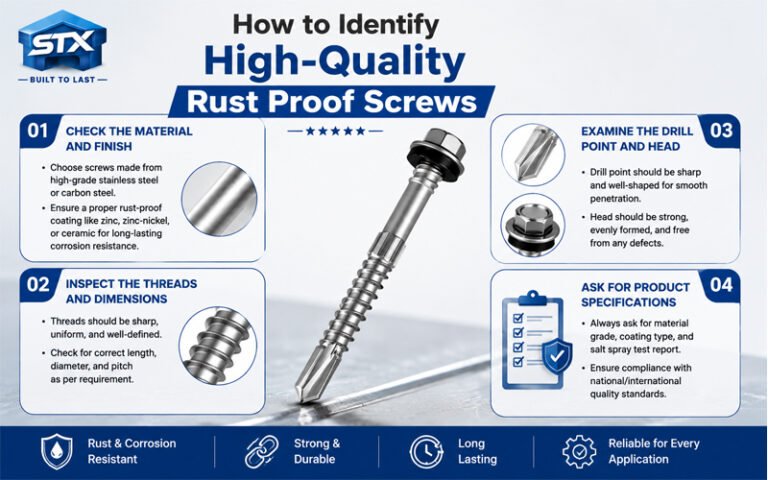
Not every screw labelled “rust proof” offers the same level of corrosion resistance or manufacturing quality. Before buying, check a few practical details instead of judging the screw only by its appearance.
Check the Material and Finish
First, identify what the screw is made from and what protective finish it has. Stainless steel provides inherent corrosion resistance, while zinc-coated or galvanized screws rely on their protective coating. The coating should be uniform, without peeling, cracks, bare spots, or heavy buildup.
Inspect the Threads and Dimensions
A quality screw should have clean, consistent threads, a properly formed head, and a uniform shaft. Damaged or uneven threads can cause poor engagement, slipping, or installation problems.
Examine the Drill Point and Head
For self-drilling screws, the drill point should be sharp and properly formed. The drive recess should also be clean and accurately shaped so the bit engages securely. Manufacturers commonly specify the screw size, point type, head type, and coating as part of the product specification.
Ask for Product Specifications
A reliable manufacturer or supplier should be able to provide details such as material, dimensions, coating/finish, application suitability, and relevant test documentation. Don’t rely only on claims like “anti-rust” or “100% rust proof.”
Quick Quality Checklist
- ✔ Uniform coating and finish
- ✔ Consistent threads and dimensions
- ✔ Properly formed drill point
- ✔ Clean, undamaged head
- ✔ Clear manufacturer specifications
- ✔ Suitable coating for the intended environment
Tip: Salt-spray test results can help compare similar coatings, but they should not be treated as a direct prediction of real-world service life because actual performance depends on several factors.
Why Choose STX Rust Proof Screws?
Choosing rust proof screws involves more than looking for a screw with a rust-resistant finish. You should also consider the screw design, application, material, size, and installation requirements.
STX offers rust-resistant self-drilling screw options for applications such as roofing, steel framing, sheet metal, and industrial fastening.
Rust-Resistant Screw Options
STX provides screw options designed for applications where corrosion resistance and reliable fastening matter. Select the appropriate material and protective finish according to the working environment.
Self-Drilling Design
Self-drilling screws use a drill-point design that can drill, tap, and fasten suitable materials in one operation. This can simplify installation for applications such as metal roofing and steel framing.
Applications
STX screw options can be considered for applications such as:
- Metal roofing and roof panels
- Steel framing
- Sheet metal work
- Metal cladding
- Industrial applications
Choose According to Your Requirement
Before ordering, confirm the required diameter, length, head type, material, coating, and application. This helps you select the right screw instead of choosing only by the “rust proof” label.
Are Rust Proof Screws Right for Your Application?
| Application | What to Consider |
|---|---|
|
Metal roofing |
Coating, washer, size and exposure |
|
Steel framing |
Material thickness and screw specification |
|
Sheet metal |
Thread design and dimensions |
|
Outdoor structures |
Corrosion protection and environment |
|
Coastal areas |
Higher corrosion exposure and suitable material/coating |
|
Industrial use |
Application requirements and documentation |
The right rust proof screws depend on the application, moisture exposure, base material, and required corrosion protection. Choose the screw specification according to the conditions where you plan to install it.
Final Verdict — Which Rust Proof Screws Should You Choose?
Choosing the right rust proof screws is less about finding one “best” screw and more about matching the screw to your application. The environment, base material, moisture exposure, coating, and required strength all matter.
Here’s a simple way to decide:
- For general indoor construction: Zinc-coated or zinc-plated screws can be a practical choice where moisture exposure is limited.
- For roofing and outdoor applications: Choose a screw with a suitable corrosion-resistant coating and the correct drill point, head, and washer for the roofing material.
- For humid or frequently wet environments: Stainless steel screws are generally a better option because their corrosion resistance comes from the material itself rather than only a surface coating.
- For coastal or salt-exposed locations: Higher-corrosion-resistance stainless steel options, such as 316, may be more appropriate.
Before buying, check the screw material, coating, dimensions, drill point, head type, and manufacturer specifications. Also make sure the screw is compatible with the material being fastened.
In short: choose zinc-coated screws for suitable standard applications, and move toward stainless steel when moisture, outdoor exposure, or corrosion risk becomes more demanding. The right screw is the one that matches your actual working environment—not simply the one labelled “rust proof.”
FAQ
Rust-proof screws are fasteners designed to provide strong resistance against rust and corrosion. They may use corrosion-resistant materials such as stainless steel or protective coatings such as zinc. The right choice depends on where the screw will be used and how much moisture or environmental exposure it will face.
Not always. “Rust proof” is commonly used to describe screws with high corrosion resistance, but no screw should be assumed to perform equally in every environment. For example, a zinc-coated screw can provide protection, but damage or wear to the coating can expose the steel underneath.
For general outdoor applications, stainless steel screws are a strong option because corrosion resistance comes from the material itself. For particularly harsh or coastal environments, higher-corrosion-resistance stainless grades may be more suitable.
It depends on the application. Stainless steel generally offers better corrosion resistance, while zinc-coated screws can be a practical choice where the environment and required protection are suitable. Consider moisture, exposure, base material, and project requirements before choosing.
Check these key factors:
- Application: roofing, construction, fabrication, or outdoor work
- Environment: dry, humid, wet, or coastal
- Material: stainless steel or coated steel
- Screw size: diameter and length
- Head and drive type: based on installation requirements
- Manufacturer specifications: confirm the screw is suitable for your application
Choosing the screw based on the actual working environment helps avoid premature corrosion and unnecessary replacement.