
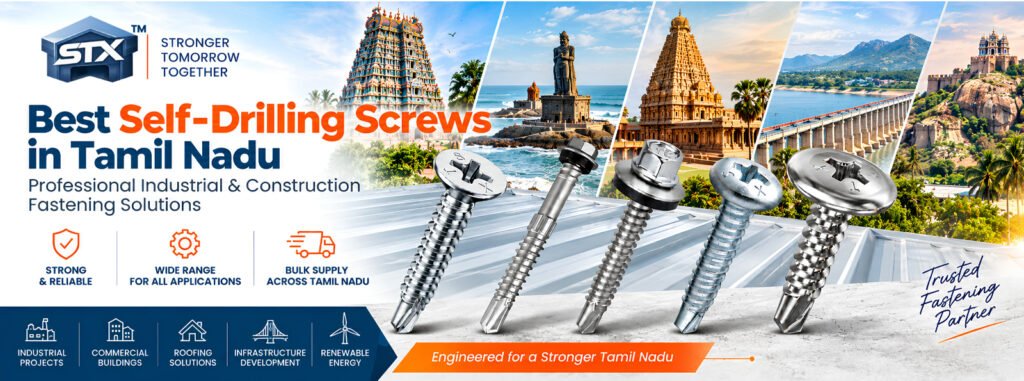
Best Self-Drilling Screws in Tamil Nadu
Finding the best self-drilling screws in Tamil Nadu can be challenging when projects involve different metal thicknesses, harsh outdoor conditions, and demanding installation requirements. The wrong fastener can cause poor drilling, weak thread engagement, corrosion, or unnecessary rework.
From construction and roofing to HVAC, engineering, and metal fabrication, each application requires the right fastening solution. A suitable self-drilling screw should match the material, thickness, drill-point design, thread profile, head type, and protective coating.
This guide explains how to choose the best self-drilling screws in Tamil Nadu for different applications. You’ll learn about screw types, materials, coatings, sizes, installation practices, common applications, and key buying factors to help contractors, fabricators, builders, and industrial buyers select the right fastener for their projects.
What Are Self-Drilling Screws?
Self-drilling screws are specialized fasteners designed to make metal fastening faster and simpler. Unlike conventional screws, they have a drill-shaped point that cuts through suitable metal while the screw is being driven. The threads then form or cut the mating thread, allowing the screw to complete the fastening process in a single installation operation.
A simple way to understand them is to think of a self-drilling screw as performing three functions during installation:
- Drilling: The fluted drill point creates the hole.
- Thread forming: The threads engage with the drilled material.
- Fastening: The head seats against the surface and clamps the materials together.
For projects that require the best self-drilling screws in Tamil Nadu, these fasteners are useful for metal roofing, sheet-metal fabrication, HVAC work, steel framing, industrial equipment, enclosures, and other metal-to-metal applications. Different head styles, including hex, pan, countersunk, truss, and wafer heads, are available for different fastening requirements.
The drill point is particularly important. Its flute provides a path for removing metal chips during drilling, while the point length needs to be suitable for the material thickness so drilling is completed before the threads fully engage.
Buyers searching for the best self-drilling screws in Tamil Nadu should consider material, thickness, drill-point capacity, thread design, head style, coating, and intended application rather than choosing a screw based only on price or appearance..
- Fast installation: Self-drilling points allow suitable metal applications to be drilled and fastened without a separate pre-drilling step.
- Reliable fastening: Properly engineered threads and drill points help provide secure engagement with compatible metal surfaces.
- Corrosion resistance: Available protective coatings are designed to help screws withstand moisture and demanding environments.
- Application versatility: Suitable solutions are available for roofing, fabrication, steel structures, cladding, HVAC, and industrial applications.
- Consistent quality: Stonex emphasizes precision engineering, durable materials, and dependable performance across its fastening range.
For example, a roofing contractor may need corrosion-resistant screws for exposed metal sheets, while a fabricator may prioritize drilling performance and secure thread engagement. Choosing the Stonex screw that matches the material, thickness, coating requirement, and application can help achieve a stronger and more dependable fastening result.
- Fast installation: Self-drilling points allow suitable metal applications to be drilled and fastened without a separate pre-drilling step.
- Reliable fastening: Properly engineered threads and drill points help provide secure engagement with compatible metal surfaces.
- Corrosion resistance: Available protective coatings are designed to help screws withstand moisture and demanding environments.
- Application versatility: Suitable solutions are available for roofing, fabrication, steel structures, cladding, HVAC, and industrial applications.
- Consistent quality: Stonex emphasizes precision engineering, durable materials, and dependable performance across its fastening range.
For example, a roofing contractor may need corrosion-resistant screws for exposed metal sheets, while a fabricator may prioritize drilling performance and secure thread engagement. Choosing the Stonex screw that matches the material, thickness, coating requirement, and application can help achieve a stronger and more dependable fastening result.
- Fast installation: Self-drilling points allow suitable metal applications to be drilled and fastened without a separate pre-drilling step.
- Reliable fastening: Properly engineered threads and drill points help provide secure engagement with compatible metal surfaces.
- Corrosion resistance: Available protective coatings are designed to help screws withstand moisture and demanding environments.
- Application versatility: Suitable solutions are available for roofing, fabrication, steel structures, cladding, HVAC, and industrial applications.
- Consistent quality: Stonex emphasizes precision engineering, durable materials, and dependable performance across its fastening range.
For example, a roofing contractor may need corrosion-resistant screws for exposed metal sheets, while a fabricator may prioritize drilling performance and secure thread engagement. Choosing the Stonex screw that matches the material, thickness, coating requirement, and application can help achieve a stronger and more dependable fastening result.
How Self-Drilling Screws Work
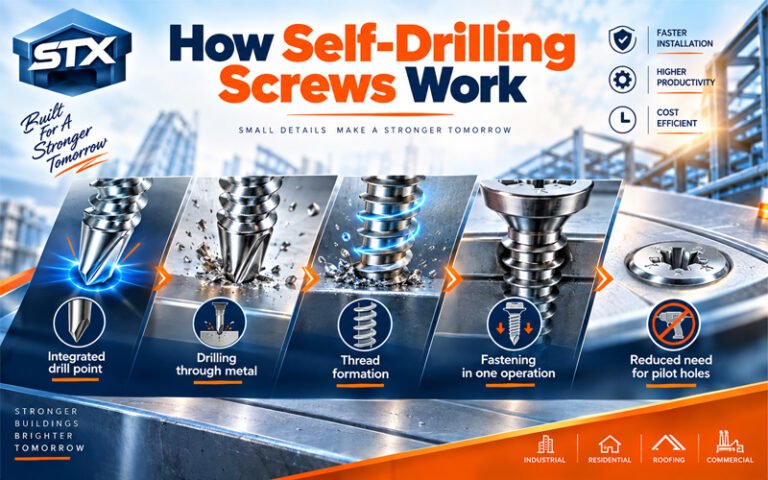
Self-drilling screws are designed to drill, form threads, and fasten in one continuous operation, making them useful for metal fabrication, roofing, HVAC, and construction applications.
- Integrated drill point: The tip works like a small drill bit, with cutting edges and flutes that penetrate the metal and remove chips during installation.
- Drilling through metal: As the screw rotates, the drill point cuts through the metal. The point length must be suitable for the material thickness so drilling is completed before the threads engage.
- Thread formation: Once the hole is created, the screw’s threads engage with the freshly drilled opening and form the mating thread.
- Fastening in one operation: The same driving action creates the hole, forms the thread, and pulls the materials together.
- Reduced need for pilot holes: Unlike conventional self-tapping screws, properly selected self-drilling screws generally eliminate a separate pilot-drilling step.
For example, when joining sheet-metal panels, the installer can position the screw, apply the appropriate driving force, and allow the drill point to penetrate before the threads secure the joint.
Self-Drilling Screws vs Self-Tapping Screws
Although self-drilling screws and self-tapping screws are often confused, their installation methods are different. A self-drilling screw has a drill-like point that creates the hole and forms the thread in the same operation. This makes it useful for metal-to-metal fastening, roofing, HVAC work, and sheet-metal applications.
A self-tapping screw forms or cuts its own thread, but for many metal applications it requires a pre-drilled or prepared pilot hole before installation.
Key differences
- Self-drilling: Drills, taps, and fastens in one operation.
- Self-tapping: Forms or cuts the thread after the hole is prepared.
- Self-drilling: Suitable when faster direct installation is required.
- Self-tapping: Useful when the hole size needs to be controlled precisely.
Example: For fixing metal roofing sheets directly to metal framing, a suitable self-drilling screw can eliminate the separate drilling step. For an assembly with an existing pilot hole, a self-tapping screw may be appropriate. Always check the manufacturer’s specifications for the material and thickness being fastened.
What Makes the Best Self-Drilling Screws in Tamil Nadu?
Choosing the best self-drilling screws in Tamil Nadu requires more than comparing appearance or price. A good screw should drill smoothly, create strong thread engagement, resist corrosion, and remain reliable under the conditions of the application. The right choice can also make installation easier and reduce the need for rework.
Key Features to Look For:
- Sharp drill point: A well-formed drill point helps the screw penetrate metal efficiently without excessive pressure.
- Strong thread design: Properly formed threads provide secure engagement and help maintain a firm connection.
- Quality steel: Suitable steel provides the strength needed for reliable fastening and consistent installation.
- Protective coating: Zinc-plated, galvanized, or other suitable coatings can improve resistance to moisture and corrosion.
- Correct screw size: The diameter and length should match the material thickness and fastening requirement.
- Suitable head and drive: The head style and Phillips drive should provide proper seating and easy installation.
- Consistent manufacturing: Uniform dimensions, sharp points, clean threads, and reliable coating quality are important for repeatable performance.
For example, a self-drilling screw for roofing may need stronger corrosion protection because it is exposed to changing weather conditions. A screw used for indoor metal fabrication may have different coating and performance requirements.
Ultimately, selecting the best self-drilling screws in Tamil Nadu means matching the fastener to the material, application, installation method, and working environment. This approach helps contractors, fabricators, builders, and industrial buyers achieve secure and dependable fastening.
Types of Best Self-Drilling Screws in Tamil Nadu
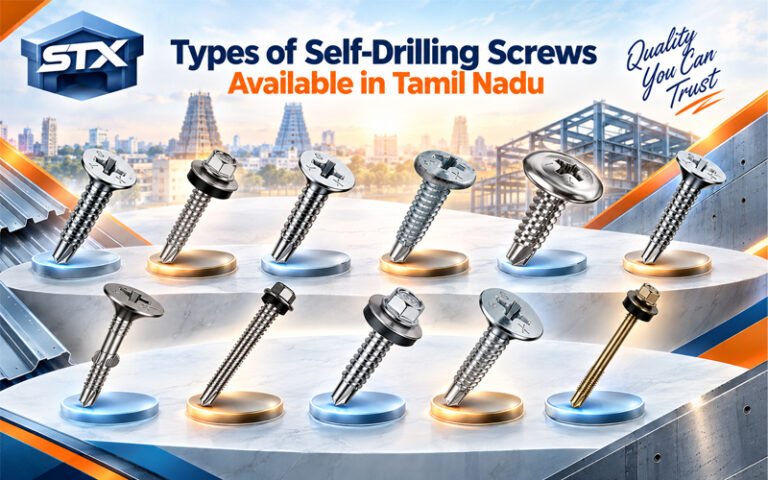
Choosing the best self-drilling screws in Tamil Nadu depends on the material, thickness, installation method, and finish required for the project. In Tamil Nadu, common options include different head designs and drill-point configurations for construction, fabrication, roofing, HVAC, electrical, and industrial applications.
Common Types
Zinc Coated Self-Drilling Screws
Zinc coated SDS are designed with a protective zinc finish and can be used where improved resistance to surface corrosion is required. They are suitable for general metal fastening and fabrication applications.
RustProof Self-Drilling Screws
RustProof self-drilling screws are suitable for applications where protection against rust and environmental exposure is an important consideration.
CSK Self-Drilling Screws
CSK self-drilling screws feature a countersunk head that can sit closer to or flush with the material surface, making them suitable where a cleaner finished appearance is required.
Pan Head Self-Drilling Screws
Pan head self-drilling screws have a rounded head profile and are commonly suited to sheet-metal, fabrication, and general metal fastening applications.
Truss Head Phillips Self-Drilling Screws
Truss head Phillips SDS provide a broad head profile and Phillips drive, making them useful for applications where greater surface coverage is required.
Bugle Head Self-Drilling Screws
Bugle head SDS are designed with a distinctive tapered head profile and are available for suitable fastening applications requiring this head design.
Countersunk Wings Self-Drilling Screws
These screws combine a countersunk head with wings, making them suitable for specific fastening applications where the screw design needs to accommodate the material and installation requirements.
Double Thread Self-Drilling Screws
Double thread SDS feature a specialised thread configuration designed for applications requiring the corresponding fastening characteristics.
Hex Washer Head Self-Drilling Screws
Hex washer head SDS provide a hexagonal drive head with a washer-style bearing surface and are widely applicable to metal fastening work.
Wafer Phillips Self-Drilling Screws
Wafer Phillips SDS have a broad, low-profile head with a Phillips drive, making them suitable for selected sheet-metal and light-gauge fastening applications.
Farmer Self-Drilling Screws
Farmer SDS are another option in the product range, designed for suitable metal fastening requirements.
The drill point is equally important. Different point configurations are designed for different material thicknesses, so the screw should be matched to the actual substrate rather than selected by appearance alone.
When selecting the best self-drilling screws in Tamil Nadu, consider the screw head, drill point, material, coating, length, and application environment together. This helps achieve cleaner installation, reliable thread engagement, and a durable fastening connection.
What Makes the Best Self-Drilling Screws in Tamil Nadu Reliable?
Choosing a self-drilling screw is not only about appearance or price. The drill point, thread profile, material, dimensions, drive, and protective finish all affect how the fastener performs in metal applications.
For Indian applications, buyers can also refer to Bureau of Indian Standards (BIS) specifications. BIS lists IS 18471:2025 — Fasteners: Drilling Screws with Tapping Screw Thread, covering drilling screws and their requirements. The standard addresses aspects such as dimensions, thread size, materials, tolerances, finish and marking.
For cross-recessed drilling screws, BIS also references related standards for pan-head, countersunk and raised-countersunk designs.
What to Check Before Buying
- Drill point: Should be properly formed for the intended metal thickness.
- Thread: Look for clean, consistent threads and suitable thread geometry.
- Material: Select steel or stainless steel according to the application.
- Coating: Match the coating to the required corrosion resistance.
- Head and drive: Choose the correct head style and compatible driver bit.
- Size: Screw diameter and length should suit the material and joint.
- Quality documentation: Ask the manufacturer or supplier about applicable standards and product specifications.
Applications of Self-Drilling Screws in Tamil Nadu
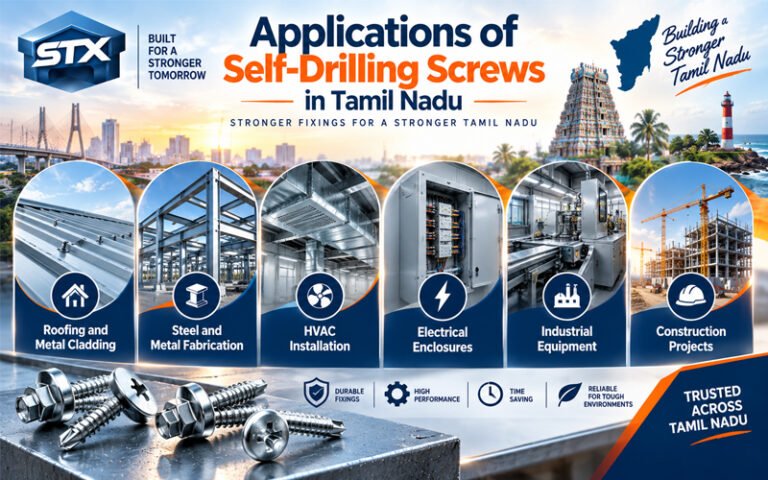
The best self-drilling screws in Tamil Nadu are widely used where metal components need to be joined quickly without a separate pre-drilling step. In Tamil Nadu, their applications are closely connected with construction, manufacturing, fabrication, roofing, HVAC, and industrial projects. The state’s Department of Economics and Statistics reports substantial activity across industries including structural metal manufacturing, fabricated metal products, basic iron and steel, electrical equipment, machinery, and motor vehicles.
Common Applications
- Roofing and Metal Cladding: Self-drilling screws are used to secure roofing sheets, wall panels, and metal cladding to supporting structures.
- Steel and Metal Fabrication: Fabricators use them for joining metal frames, brackets, panels, and light-gauge steel components.
- HVAC Installation: They are useful for fastening ductwork, sheet-metal components, supports, and enclosures.
- Electrical Enclosures: Self-drilling screws can help assemble metal cabinets, panels, and equipment enclosures where secure sheet-metal fastening is required.
- Industrial Equipment: Manufacturing and engineering projects use suitable screw types for assembling metal components and protective covers.
- Construction Projects: They are commonly selected for metal framing, partitions, panels, and other fastening applications.
Tamil Nadu’s industrial ecosystem provides a strong setting for these applications. SIPCOT states that it has developed 50 industrial parks and eight SEZs across 24 districts, supporting industrial activity throughout the state.
The key is to select the screw according to the metal thickness, drill-point design, thread pattern, material, and coating. Choosing the right self-drilling screw helps achieve dependable fastening while reducing unnecessary installation effort.
How to Choose the Right Self-Drilling Screw
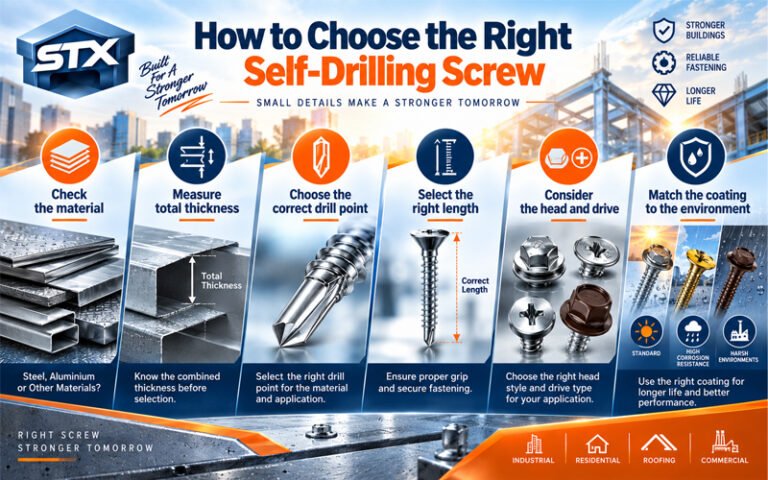
Choosing the best self-drilling screws in Tamil Nadu is not simply about picking a screw that fits the hole. The material, thickness, drill point, length, coating, and application all affect fastening performance.
Key Factors to Consider
- Check the material: Identify whether you are fastening sheet metal, steel sections, aluminium, or another material. Material hardness can affect drilling performance.
- Measure total thickness: Consider the combined thickness of all layers being joined, rather than measuring only the top sheet.
- Choose the correct drill point: The drill point must be capable of penetrating the complete material thickness before the threads begin engaging. An unsuitable point can cause slow drilling, overheating, or premature failure.
- Select the right length: Make sure the screw provides adequate thread engagement while avoiding unnecessary projection beyond the material.
- Consider the head and drive: Pan head, truss head, countersunk, and hex washer head screws serve different fastening requirements.
- Match the coating to the environment: Indoor applications may require different corrosion protection from roofing, outdoor, or coastal installations.
For example, a screw used for HVAC ducting may require a different specification from one used for roofing, steel fabrication, or industrial equipment. Always check the manufacturer’s drilling-capacity and application specifications before selecting the fastener.
Why Screw Quality Matters
When selecting the best self-drilling screws in Tamil Nadu, buyers should evaluate manufacturing quality beyond appearance or price alone. A good screw must drill cleanly, create reliable thread engagement, hold the materials securely, and remain suitable for the surrounding environment. The drill point, thread accuracy, material, heat treatment, coating, and washer can all affect performance.
This becomes especially important in Tamil Nadu, where self-drilling screws are used across construction, roofing, metal fabrication, HVAC, electrical enclosures, and industrial applications. India’s finished steel consumption reached 152.13 million tonnes in 2024–25, reflecting the scale of steel use across sectors where reliable fastening is important.
What can happen with poor-quality screws?
- Poor drilling: A weak or improperly formed drill point may struggle to penetrate the metal.
- Thread failure: Inaccurate threads can result in weak or inconsistent holding.
- Corrosion: An unsuitable coating can reduce service life in humid or exposed environments.
- Installation problems: Excessive heat, over-tightening, or incorrect tools can damage the screw and surrounding material.
- Higher rework: Broken points, damaged threads, and loose fasteners can increase installation time and replacement costs.
For this reason, choosing the best self-drilling screws in Tamil Nadu means looking beyond the product label. Check the screw’s material, drill-point design, coating, thread profile, dimensions, and suitability for the specific application. A properly manufactured screw can provide more consistent installation and dependable fastening performance.
Best Self-Drilling Screws for Different Applications
Choosing the best self-drilling screws in Tamil Nadu depends on the material, thickness, environment, and fastening requirements of each project. Different applications need different screw designs, drill points, heads, and coatings. Here are some common examples:
Roofing and Metal Sheets
When selecting the best self-drilling screws in Tamil Nadu for roofing, choose screws designed to fasten metal sheets securely to steel framing. Screws with sealing washers can help create a more reliable water-resistant connection. Roofing applications also include overlapping sheets, insulated roofs, and edge reinforcement.
HVAC and Ducting
HVAC fabrication commonly uses self-drilling screws for joining sheet-metal components and fastening profiles. Compact screws with suitable drill points are useful where installation space is limited.
Steel Framing and Fabrication
For steel frames, trusses, joists, and metal profiles, select screws according to the combined thickness of the materials. The drill point should be matched to the metal being fastened to support clean and consistent installation.
Industrial and General Metal Work
For buyers comparing the best self-drilling screws in Tamil Nadu for general metal-to-metal fastening, coated carbon-steel screws can be suitable for indoor and selected outdoor environments. while corrosion-resistant options may be preferable where exposure conditions are more demanding.
Tip: Before buying, check the screw’s material, coating, drill-point design, head type, and recommended application rather than choosing only by appearance or price.
Self-Drilling Screws in Chennai and Across Tamil Nadu
The demand for self-drilling screws in Chennai and across Tamil Nadu is closely connected with the state’s strong manufacturing, construction, engineering, roofing, and fabrication sectors. Tamil Nadu’s industrial base includes machinery and equipment, automobiles, electronics, construction, and other manufacturing activities, creating a wide range of applications for reliable metal fastening solutions.
In Chennai, self-drilling screws are commonly considered for applications such as:
- Roofing and cladding – fastening metal roofing sheets and panels.
- HVAC and ducting – securing sheet-metal components and ductwork.
- Steel fabrication – joining light-gauge and structural metal components.
- Electrical work – fixing enclosures, panels, and cable-management components.
- Industrial equipment – assembling metal frames, panels, and fabricated parts.
- Construction projects – fastening metal sheets, profiles, and building components.
Tamil Nadu’s industrial production data also shows continued activity across manufacturing and construction-related categories. The state’s official industrial production report recorded growth in manufacturing and construction goods during the reported period.
For buyers, choosing a suitable screw is about more than simply finding a fastener nearby. Material, drill-point design, thread configuration, head style, coating, and application requirements should all be considered. For example, a coated screw may be more appropriate where corrosion resistance is important, while a particular drill-point design may be better suited to the thickness of the metal being joined.
Whether you are sourcing in Chennai, Coimbatore, Madurai, Salem, Tiruchirappalli, or other parts of Tamil Nadu, selecting the right self-drilling screw can help achieve consistent fastening and dependable installation results.
How to Identify a Reliable Self-Drilling Screw Manufacturer
Choosing a reliable manufacturer is important when sourcing the best self-drilling screws in Tamil Nadu because screw quality can affect drilling performance, fastening strength, durability, and installation efficiency. A dependable manufacturer should offer consistent products, suitable materials, and clear product specifications rather than focusing only on price.
When evaluating a manufacturer, consider these factors:
- Material quality: Check whether the screws are made from suitable steel and are appropriate for the intended application.
- Drill-point quality: A properly formed drill point should penetrate the required metal smoothly and reduce installation difficulties.
- Thread consistency: Well-formed threads provide better engagement and help create a secure fastening connection.
- Coating and finish: Select a suitable protective coating when screws will be exposed to moisture, weather, or corrosive environments.
- Quality control: Ask about inspection and testing procedures used during manufacturing to maintain consistent product quality.
- Product specifications: Reliable manufacturers should clearly provide information about screw dimensions, materials, head types, drill points, and coatings.
- Product range: A manufacturer offering different screw designs and finishes can help you select products according to specific project requirements.
- Technical support: Good manufacturers should be able to explain which screw is suitable for roofing, sheet-metal fabrication, HVAC work, construction, or industrial applications.
For example, screws used for outdoor roofing may require a protective finish suited to exposure, while screws used for indoor metal fabrication may have different requirements. Comparing material, drill-point design, thread profile, coating, and application suitability helps you choose a manufacturer based on quality, performance, and reliability rather than price alone.
Installation Tips for Self-Drilling Screws
Correct installation is essential for getting strong, clean, and long-lasting results from the best self-drilling screws in Tamil Nadu. Although these screws are designed to drill and fasten in one operation, the right screw, tool, speed, and driving technique still matter. Manufacturer guidance notes that excessive speed can generate heat and damage the drill point, while excessive tightening can strip threads or overstress the fastener.
Follow these practical tips:
- Choose the right screw: Match the drill-point design, screw length, diameter, material thickness, and coating to the application.
- Use the correct driver bit: Select a properly fitting Phillips bit or socket to prevent slipping and head damage.
- Keep the screw straight: Hold the driver perpendicular to the metal surface so the drill point can cut cleanly.
- Apply steady pressure: Maintain firm, controlled pressure while the drill point penetrates the material. More pressure is not always better.
- Control the speed: Use the manufacturer’s recommended speed for the particular screw and base material. Excessive RPM can overheat and damage the drill point.
- Avoid overdriving: Once the screw head is properly seated, stop driving. Over-tightening can strip threads or damage the material.
Example: When fastening a metal panel to a steel frame, position the panel securely, place the screw at the fixing point, keep the driver straight, and allow the drill point to penetrate before reducing pressure as the threads engage.
Following these simple practices helps achieve secure fastening, consistent installation, and better screw performance.
Common Mistakes When Buying Self-Drilling Screws
Buying the best self-drilling screws in Tamil Nadu may seem simple, but choosing the wrong specification can lead to poor drilling, weak thread engagement, damaged screw heads, and unnecessary installation delays.The key is to select the screw based on the actual application rather than price or appearance alone.
Common Buying Mistakes to Avoid
- Choosing only by size: Diameter and length are important, but they are not enough. Check the material thickness, drill-point capacity, thread design, head type, and coating as well.
- Ignoring total material thickness: If the screw passes through multiple metal layers, consider the combined thickness when selecting the drill point. An unsuitable point can cause overheating, slow drilling, or breakage.
- Selecting the wrong coating: Indoor and outdoor applications may require different corrosion protection. Humid, coastal, and industrial environments need careful coating selection.
- Buying without checking the driver bit: A poorly matched bit can cause slipping, cam-out, and damage to the screw head.
- Choosing based only on the lowest price: Consistent drill-point hardness, coating quality, thread formation, and manufacturing control can directly affect installation performance.
A Simple Buyer Checklist
Before placing an order, confirm the material, total thickness, screw diameter, length, drill point, head and drive type, coating, and application environment. For important projects, test the selected screw on the actual material before purchasing in bulk. This practical step can reveal drilling or thread-engagement problems before they affect the entire project.
Why Choose Stonex Screws for Self-Drilling Applications?
Choosing the right self-drilling screw can make a noticeable difference in installation quality, fastening strength, and long-term performance. Stonex Screws focuses on fastening solutions designed for roofing, construction, fabrication, and industrial applications. Its product range is positioned around quick installation, reliable grip, corrosion resistance, and consistent performance.
India’s demand for steel-based construction and industrial applications continues to create a strong need for dependable fastening products. The Ministry of Steel reports that housing and construction account for 43% of India’s steel consumption, while infrastructure accounts for another 25%. This highlights why selecting suitable fasteners for metal-based applications is important.
Key reasons to consider Stonex Screws:
- Fast installation: Self-drilling points allow suitable metal applications to be drilled and fastened without a separate pre-drilling step.
- Reliable fastening: Properly engineered threads and drill points help provide secure engagement with compatible metal surfaces.
- Corrosion resistance: Available protective coatings are designed to help screws withstand moisture and demanding environments.
- Application versatility: Suitable solutions are available for roofing, fabrication, steel structures, cladding, HVAC, and industrial applications.
- Consistent quality: Stonex emphasizes precision engineering, durable materials, and dependable performance across its fastening range.
For example, buyers choosing the best self-drilling screws in Tamil Nadu for roofing may need corrosion-resistant screws for exposed metal sheets, while fabricators may prioritize drilling performance and secure thread engagement. Choosing the Stonex screw that matches the material, thickness, coating requirement, and application can help achieve a stronger and more dependable fastening result.
Conclusion
Finding the best self-drilling screws in Tamil Nadu starts with understanding the application, material, and installation requirements rather than choosing a screw based only on price. Metal thickness, screw material, drill-point design, thread profile, head type and protective coating should all be considered before making a purchase.
For roofing, sheet-metal work, HVAC installations, electrical enclosures, fabrication and other metal applications, the right self-drilling screw can make installation more convenient and help create a dependable fastening connection.
Buyers should also pay attention to product specifications and applicable Indian Standards. IS 18471:2025 provides an important reference for drilling screws with tapping screw threads, including requirements relating to dimensions, materials, threads, finish and marking.
When comparing suppliers in Tamil Nadu, look beyond a simple product name. Check the material, dimensions, drill point, coating, available sizes, application suitability and quality documentation. This approach makes it easier to select screws that match the actual requirements of your project.
If you are looking for reliable self-drilling screws for industrial, construction or fabrication applications, contact StoneX Screws to discuss your requirement and find a suitable fastening solution.
FAQ
The best self-drilling screw depends on the material, thickness, application, and environmental conditions. For roofing, cladding, fabrication, HVAC, and metal framing, the screw should have the appropriate drill point, thread design, head style, material, and protective coating.
They are commonly used in metal roofing, wall cladding, steel fabrication, PEB buildings, HVAC systems, electrical enclosures, warehouses, and industrial equipment. The exact screw specification should match the application and substrate.
Start by checking the base material and total thickness. Then consider the drill-point capacity, screw length, diameter, head type, thread engagement, coating, and whether a sealing washer is required. Selecting only by screw length can lead to poor fastening performance.
Yes. They are widely used for metal roofing and cladding because they can drill and fasten suitable metal sheets in the same installation operation. Roofing applications may also require a suitable washer and corrosion-resistant finish for the service environment.
For bulk or project purchases, check material grade, drilling capacity, dimensions, coating, corrosion requirements, head style, quality consistency, and application suitability. For outdoor or coastal environments, the required corrosion protection should be considered carefully rather than selecting a coating based only on appearance.